> ## Documentation Index
> Fetch the complete documentation index at: https://poolerz.mintlify.site/llms.txt
> Use this file to discover all available pages before exploring further.
# Component Design
> The component design of Poolerz.
The diagrams below provide a **detailed breakdown of our application’s static and dynamic architectures**, showcasing **relationships, dependencies, method overviews, and system components**.
* **Static Architecture:** Expands on the general system architecture (Figure 1) by breaking down the **frontend, backend, and database layers**, showing interactions during carpool creation and joining.
* **Dynamic Architecture:** Builds on the static architecture by **demonstrating user interactions** and **response flows** across layers.
Together, these diagrams provide a **comprehensive architectural view** of our application.
***
## **Static Component Architecture**
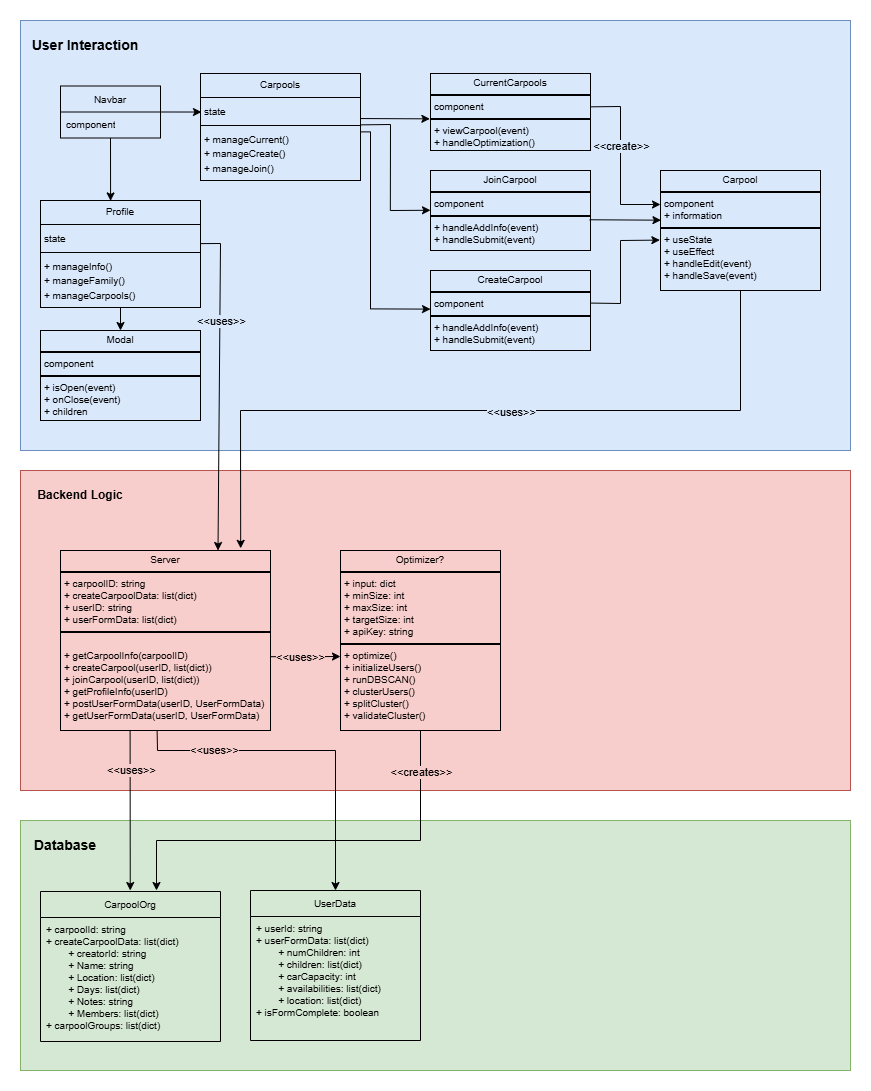 The **static component diagram** (Figure 3.1) outlines the **key system elements** and their interactions.\
Instead of a **traditional component diagram**, we use a **class diagram** to clearly depict:
* **Application elements**
* **Interactions across layers**
### **Key Layers & Components**
#### **Frontend Layer**
This layer consists of UI components that the **user directly interacts with**:
* **Profile**
* **Modal**
* **JoinCarpool**
* **CreateCarpool**
These components handle:
* **Displaying user interfaces**
* **Accepting user input**
* **Interacting with the backend for functional operations**
*Annotations like* `<>` *and* `<>` *indicate dependencies between components.*
#### **Business Logic Layer**
This layer includes:
* **Server & Optimizer**: Handles data retrieval, user updates, and carpool grouping logic.
#### **Database Layer**
* The **backend interacts with the database** to update:
* **Carpools Collection:** Stores **carpool details, schedules, and members**.
* **UserData Collection:** Stores **user profiles and personal details**.
Figure 3.1 presents a **clear structural overview** of how these components work together.
***
## **Dynamic Component Architecture**
The **static component diagram** (Figure 3.1) outlines the **key system elements** and their interactions.\
Instead of a **traditional component diagram**, we use a **class diagram** to clearly depict:
* **Application elements**
* **Interactions across layers**
### **Key Layers & Components**
#### **Frontend Layer**
This layer consists of UI components that the **user directly interacts with**:
* **Profile**
* **Modal**
* **JoinCarpool**
* **CreateCarpool**
These components handle:
* **Displaying user interfaces**
* **Accepting user input**
* **Interacting with the backend for functional operations**
*Annotations like* `<>` *and* `<>` *indicate dependencies between components.*
#### **Business Logic Layer**
This layer includes:
* **Server & Optimizer**: Handles data retrieval, user updates, and carpool grouping logic.
#### **Database Layer**
* The **backend interacts with the database** to update:
* **Carpools Collection:** Stores **carpool details, schedules, and members**.
* **UserData Collection:** Stores **user profiles and personal details**.
Figure 3.1 presents a **clear structural overview** of how these components work together.
***
## **Dynamic Component Architecture**
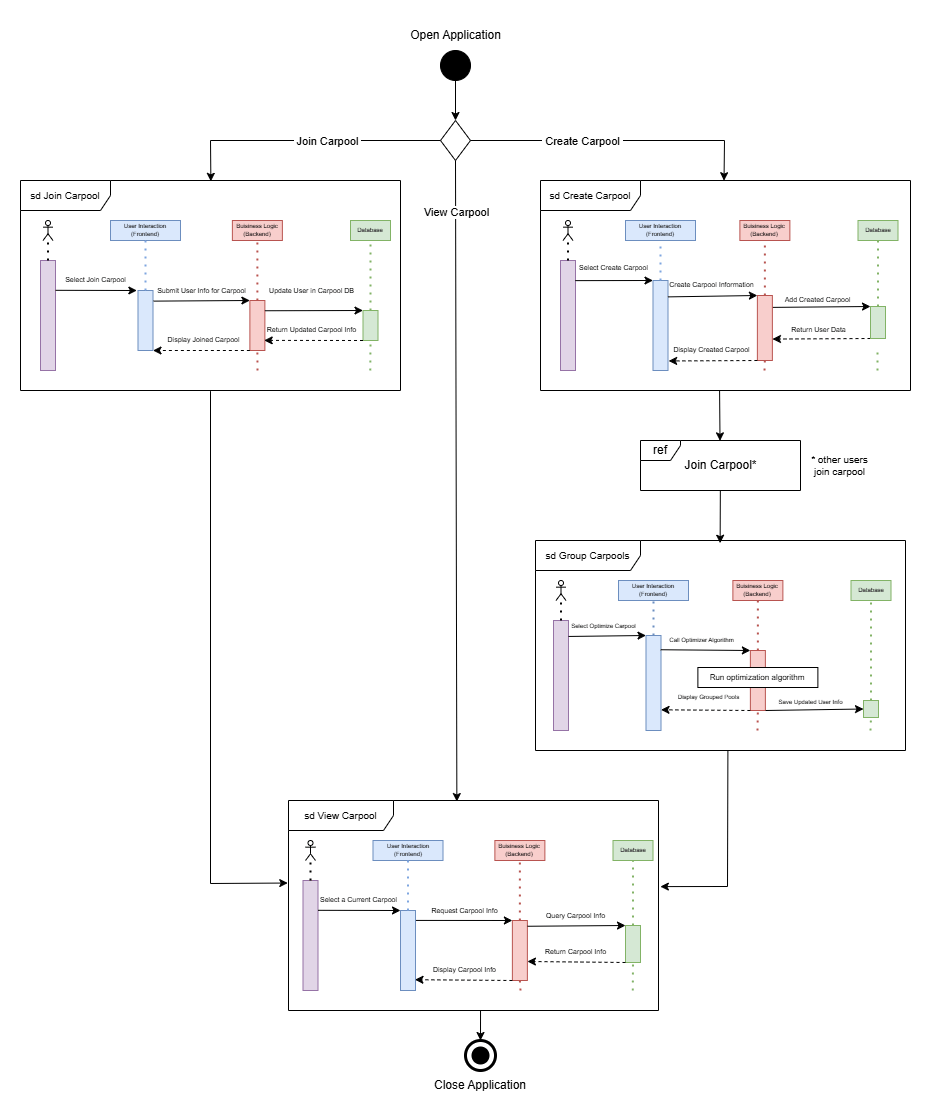 The **dynamic architecture diagram** (Figure 3.2) illustrates the **user flow** when:
1. **Joining a carpool**
2. **Creating a carpool**
3. **Viewing a carpool**
We utilize an **interaction overview diagram** to display:
* **Primary user flows**
* **Multiple sequence diagrams nested within different processes**
### **Key User Flows**
#### **1. Joining a Carpool**
* **User selects a carpool** from the UI.
* **Data is sent to the backend**, where the system:
* **Adds the user to the carpool database**.
* **Sends confirmation of successful join**.
#### **2. Creating a Carpool**
* **User inputs carpool details** via the frontend.
* **Backend processes the request** and:
* **Creates a new carpool entry in the database**.
* **Returns confirmation of creation to the frontend**.
#### **3. Viewing a Carpool**
* **User selects a carpool to view**.
* **Frontend requests carpool details from the backend**.
* **Backend queries the database** and:
* **Retrieves relevant data**.
* **Returns the information to be displayed on the UI**.
Figure 3.2 effectively captures **real-time user interactions**, ensuring a **seamless user experience** across **frontend, backend, and database layers**.
***
By integrating **both static and dynamic architecture models**, our design ensures:
* **Clear system structure**
* **Efficient data flow**
* **Scalability and maintainability**
The **dynamic architecture diagram** (Figure 3.2) illustrates the **user flow** when:
1. **Joining a carpool**
2. **Creating a carpool**
3. **Viewing a carpool**
We utilize an **interaction overview diagram** to display:
* **Primary user flows**
* **Multiple sequence diagrams nested within different processes**
### **Key User Flows**
#### **1. Joining a Carpool**
* **User selects a carpool** from the UI.
* **Data is sent to the backend**, where the system:
* **Adds the user to the carpool database**.
* **Sends confirmation of successful join**.
#### **2. Creating a Carpool**
* **User inputs carpool details** via the frontend.
* **Backend processes the request** and:
* **Creates a new carpool entry in the database**.
* **Returns confirmation of creation to the frontend**.
#### **3. Viewing a Carpool**
* **User selects a carpool to view**.
* **Frontend requests carpool details from the backend**.
* **Backend queries the database** and:
* **Retrieves relevant data**.
* **Returns the information to be displayed on the UI**.
Figure 3.2 effectively captures **real-time user interactions**, ensuring a **seamless user experience** across **frontend, backend, and database layers**.
***
By integrating **both static and dynamic architecture models**, our design ensures:
* **Clear system structure**
* **Efficient data flow**
* **Scalability and maintainability**